Solar energy is a “set it and forget it” investment often touted. After the panels are installed, many commercial and industrial users believe little intervention is needed and the system will continue to provide a consistent supply of energy for decades to come.
Solar maintenance services providers like Solar Sweep, which specialize in solar panel cleaning and performance optimization, play an important role in helping businesses maintain and restore system efficiency over time.
However, solar installations are more akin to industrial machinery than fixed infrastructure. They work outside in a dusty, polluted atmosphere, subjected to heat and changing weather. Eventually, these conditions cause gradual performance degradation, which is sometimes not noticeable at first.
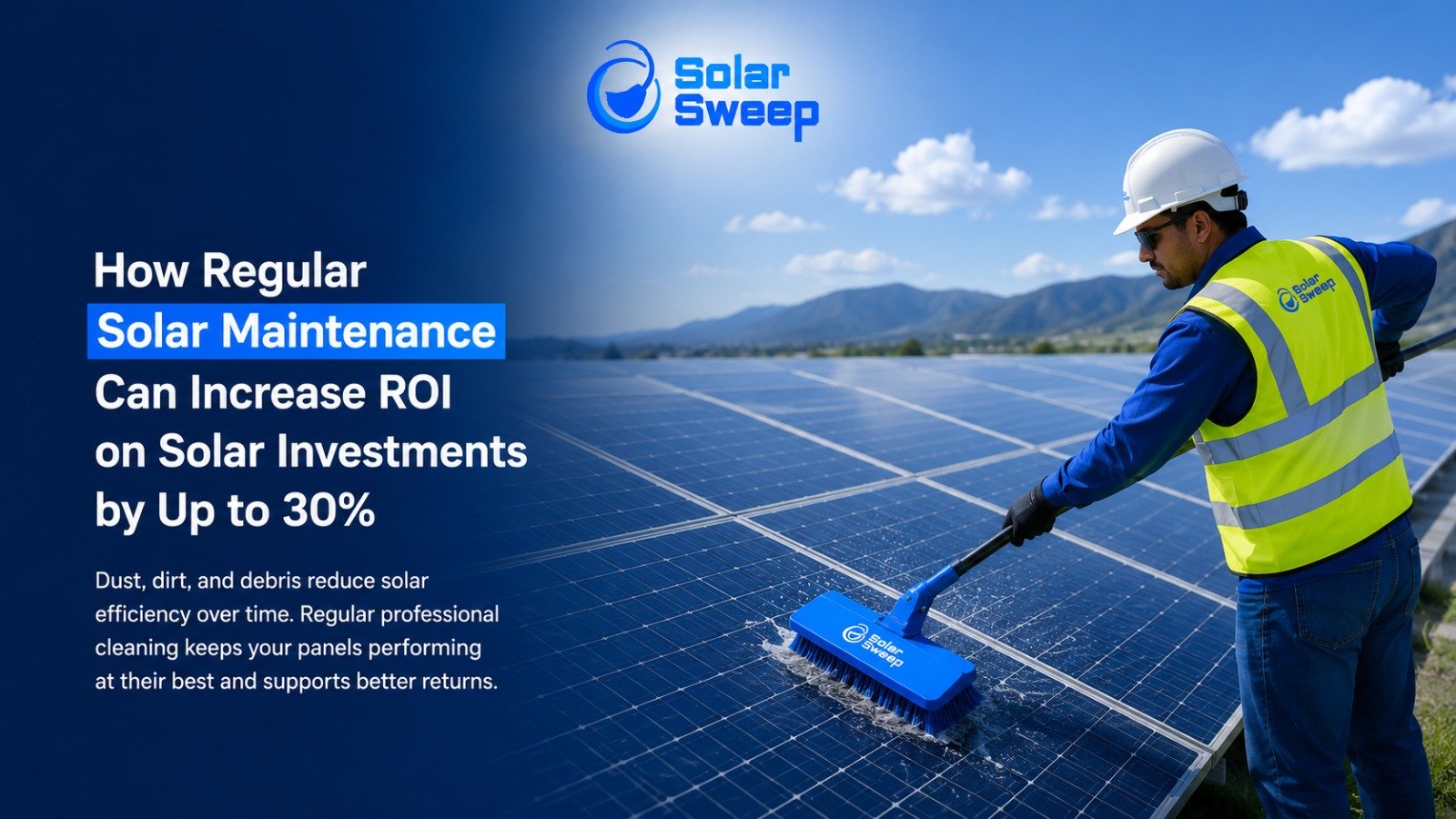
In the case of commercial users, this is an extra cost that impacts the return on investment (ROI). The good news is that most of this loss is not permanent. By performing regular maintenance, a large amount of the lost efficiency can be regained in the system, sometimes increasing the ROI by 20-30% depending on the system condition and the environment.
Table of Contents
Why ROI depends on more than just installation quality
The major factors that businesses consider when calculating ROI on solar investment are the size of the system, the estimated amount of energy produced, and the cost of installation. These calculations are done under ideal conditions, however, such as clean panels, optimal angles, and consistent sunlight exposure.
When the model is used in real situations, the assumptions mentioned earlier are not strictly satisfied.
Dust, pollution, bird droppings or environmental debris decrease the efficiency of the panels. Components of the electrical system may degrade slightly over time. Wires and connectors might wear. If losses are experienced on a few panels, they add up to substantial output losses.
That is, if not maintained, the actual ROI can be lower than the projected ROI.
How performance degradation affects financial returns
Commercial users may be affected financially by even minor reductions in solar efficiency.
For instance, if it runs at a slightly lower efficiency it will produce less electricity every day. This decreases energy savings over the course of more than a month. It results in greater reliance on the electricity grid over the course of the year. It can greatly increase the payback period of the entire system over the years.
The problem is that degradation is often a slow process. There could be a gradual decrease in the businesses’ anticipated savings.
That’s where maintenance becomes cost-effective — restores and maintains optimum system output before losses occur.
The role of dust and environmental buildup in ROI loss
Environmental factors contribute significantly to the loss in solar performance in a country such as Pakistan.
Particles of dust, pollution and air settle on solar panels and form a thin layer that prevents sunlight from reaching the panels. If not visibly apparent, this layer decreases your energy absorption and decreases output.
This accumulation occurs more rapidly in industrial and commercial areas where the levels of emissions, construction activity and traffic pollution are higher.
A soiling effect can also occur if left unwashed for extended periods, and can significantly affect system efficiency at a level that can be felt in monthly energy savings.
In large commercial systems, a few percent decrease in efficiency can mean a big loss of money in the long run.
How maintenance restores lost efficiency
The key benefit with solar systems is that the soiling losses can be recovered.
Properly cleaned and maintained panels keep dust and dirt away from the PV cells so that the sunlight can pass through them unhindered.
This frequently causes a system boost right away. Businesses notice an improvement in their energy generation following maintenance, particularly when they did not have it for several months.
It’s one of the most important reasons why ROI is directly affected by maintenance.
Why up to 30% ROI improvement is realistic
With several factors combined, the possibility of achieving up to 30% enhanced ROI with regular maintenance emerges:
The first advantage is that the lost efficiency due to dust and pollution can be regained and thus the system can be returned to its designed performance level.
Second, these small problems can lead to further degradation of performance if they are not identified and resolved early on, such as loose connections, shading issues, inverter efficiency, and so on.
Third, steady production eliminates reliance on grid power, thus directly enhancing energy cost savings.
Over time, this plus all the other improvements can make a huge difference in total energy output in environments where there is a risk of soiling and environmental exposure.
Maintenance as a cost-saving strategy, not an expense
For most commercial users, maintenance is perceived as an extra expense. With solar energy systems, though, the maintenance should be viewed as an investment protection plan.
Systems will slowly lose productivity without maintenance, which decreases returns and increases payback times. Systems run closer to their optimum efficiency with maintenance, maximizing savings.
That is, maintenance does not add to costs, it protects and adds to revenue generation from the solar system.
This change in thinking is particularly crucial in industries with high energy demands where efficiency gains, even in the smallest of proportions, can mean significant savings.
Key maintenance activities that improve ROI
There are a number of essential tasks that are part of a regular solar maintenance.
- Cleaning solar panels to prevent dust buildup and environmental factors.
- Checking system parts to determine wear or damage
- Inspecting connections for electric losses
- Track performance results and look for improvement opportunities
- Maintaining optimum operating conditions throughout the system.
All of these events help to keep energy production steady and, as a result, improve ROI.
Some companies specialize in these maintenance processes, working to ensure that commercial users can keep their systems running for years to come and maximize their return on investment (ROI).
The impact of maintenance frequency on performance
Overall system efficiency is determined by the frequency of maintenance.
Solar panels attract dust particles faster in high dust and high pollution areas. Whereas, if cleaning is done only on an occasional basis, there will be ongoing loss of performance.
But regular maintenance keeps the system running at close to optimum performance.
This helps to avoid a long-term loss of efficiency and stabilizes energy output, a factor that is essential for businesses that depend on consistent energy savings.
Industrial and commercial advantages of optimized solar performance
Solar power is not only sustainable for industrial customers, it’s also cost-effective.
Industrial, storage and commercial buildings use a tremendous amount of electricity per day. Just a small efficiency boost in solar can result in big savings in running costs.
With proper maintenance, solar systems can generate more stable energy production, which can help reduce the need for grid electricity and enhance energy cost management.
That’s why maintenance is a big component of the operational efficiency strategy, and not merely a technical fix.
Final thoughts
While solar energy investments provide a high return, it is only when the systems function at steady-state efficiencies that this return is realized.
Dust and pollution and other factors in the environment gradually affect the performance, which decreases the ROI in comparison to the returns.
These losses can be recovered and prevented with regular cleaning and maintenance of the system, resulting in significantly better system performance.
This can equate to up to 30% ROI improvements for commercial and industrial users depending on system conditions and maintenance practices.
In the end, solar maintenance is more than just about cleaning panels, it’s about ensuring the financial value of the entire energy investment for its lifetime.