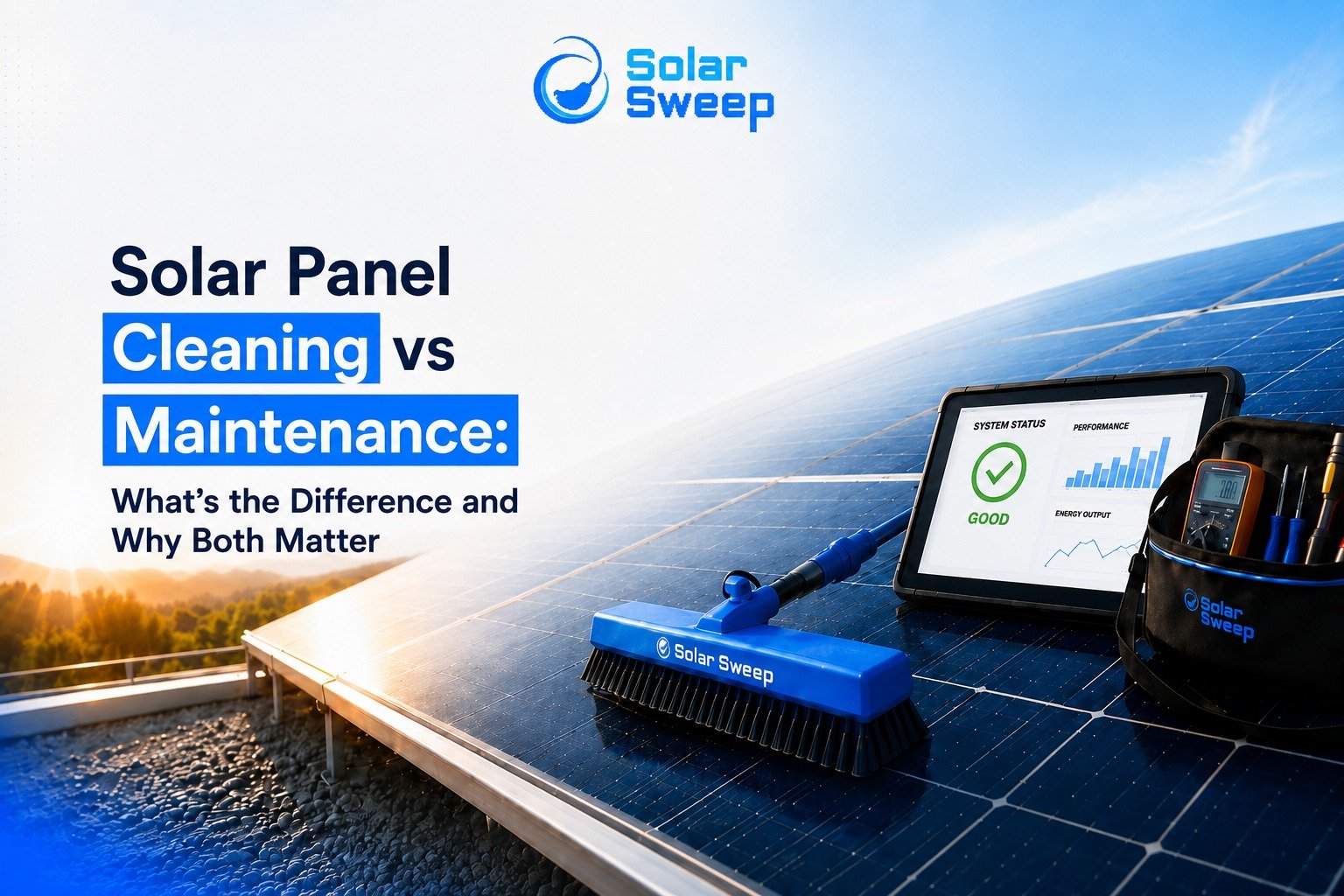
In solar power, the terms cleaning and maintenance are used synonymously. Many residential and commercial users think they are the same: maintenance of solar panels. But actually, they are vastly different, and for different purposes in a solar energy system.
This is a standard confusion in the market, particularly in the developing solar market such as Pakistan where the awareness of long term system maintenance is still in the process of development. It is crucial to know the difference between cleaning and maintenance because each directly impacts system performance, efficiency and long-term return on investment.
Companies like Solar Sweep, which focus on solar panel cleaning and maintenance services, often emphasize that maximum performance comes not from one service alone, but from both working together.
Table of Contents
What is solar panel cleaning?
Cleaning of solar panels is a process of physically removing dirt, dust, pollution, bird droppings and other environmental contaminants from solar panels.
This is its job: to bring back sunlight.
Solar panels produce power by capturing sunlight with PV cells. Dust or dirt that falls on the surface of the cells causes a reduction or scattering of sunlight prior to reaching the cell. Any sort of dust will lessen efficiency.
The answer to this direct problem is cleaning, which makes the surface of the panel clear for the maximum passage of the sun’s rays.
Key characteristics of cleaning:
- Only pay attention to the surface cleanliness
- Replaces the sunlight’s absorption in a direct manner
- Short-term performance improvement
- Essential often based on habitat
Simply put, cleaning is the process of eliminating visible and invisible obstacles to sunlight.
What is solar maintenance?
Solar maintenance is a more extensive and complicated procedure. It involves inspection, performance monitoring, system checks and minor corrective actions for the solar system to ensure that the entire system is working well.
Cleaning is not the same as maintenance, which is more than just a panel cleaning. It views the entire solar system as a functioning system.
Maintenance typically includes:
- Electrical system inspection
- Checking wiring and connections
- Inverter performance monitoring
- Structural stability checks
- Identifying faults or performance drops
- Ensuring the safety and efficiency of the system.
Maintenance ensures that the solar system is clean, but also optimised for function and technically healthy.
The core difference between cleaning and maintenance
To frame the difference in a simple way, it is as follows:
- Cleaning increases the amount of sunlight reaching the surface.
- Maintenance makes system performance better.
Cleaning is mechanical and superficial. Maintenance is technical and system level.
If dust was the primary problem, cleaning can have immediate impact on output. Maintenance is provided to keep the system running efficiently over time with no hidden technical losses.
One is about sight. The other one is about what you can’t see.
Why cleaning alone is not enough
Solar users often think they clean panels from time to time and that’s sufficient to keep them working. Cleaning is vital but it is only part of the answer.
Even if the panels are perfectly clean, a solar system may still be suboptimal.
For example:
- A faulty/inverter will cause loss of output.
- The loss of energy can occur because of loose wiring.
- Shading can cause loss of efficiency of the panel.
An imbalanced system can cause loss of system performance.
However, in these situations, cleaning will not resolve the issue as it is a problem within the system.
This is why it is dangerous to only rely on cleaning for your system’s health.
Why maintenance alone is also not enough
However, maintenance without cleaning also has its drawbacks.
Dust on panels will still decrease the amount of sunlight absorbed and consequently decrease energy production even if all electrical components are functioning well.
It can be technically correct, but not performing its best because of environmental issues.
Thus, while maintenance improves system health, it is ineffective in improving the performance of the system unless the panels are clean.
How cleaning and maintenance work together
Cleaning and maintenance are not competing services — they are complementary.
Together they are responsible for both:
- maximum sunlight absorption
- optimal system functionality
Cleaning brings the surface back to its optimal condition to capture 100% of the energy. Maintenance is the provision of adequate and efficient conversion of captured energy.
They form a complete solar system performance optimization process together.
The role of environment in deciding service needs
In countries such as Pakistan, the need to clean as well as maintain is on par due to environmental conditions.
Solar performance can be affected by a variety of factors including but not limited to dust, pollution, humidity and seasonal weather changes.
For example:
- Cleaning problem – dust robs panels from their efficiency
- Heat has an impact on the electrical performance (maintenance issue)
- Wiring and connections could be vulnerable to moisture (Maintenance issue)
- Soiling rate (cleaning issue) is increased due to pollution.
Due to the synergy of these factors, solar systems can only be operated under stable conditions when both services are provided.
Furthermore, it shows the impact on commercial and industrial solar systems.In addition, it’s used in commercial and industrial solar systems.
Impact on commercial and industrial solar systems
Large-scale systems require reliable energy production to lower overall operating costs. If there are any losses in the ability to be efficient, there can be huge monetary consequences in the long run.
Even when panels are clean, the system might still be inefficient in terms of electricity use, and this can result in losses of energy. Likewise, when the system is kept in perfect condition, but the panels are unclean output is reduced.
That’s why, more and more, industrial users are moving to structured solar operations and maintenance (O&M) practices, incorporating cleaning and technical servicing.
How combined service improves ROI
Regular cleaning in conjunction with maintenance allows the solar system to run closer to design efficiency.
This leads to:
- higher energy generation
- reduced performance losses
- These days, businesses can enjoy greater returns in shorter time.
- longer system lifespan
By implementing regular cleaning + maintenance schedules instead of sporadic cleaning, users often remark on an improvement in the performance of the equipment.
But service companies like Solar Sweep specialize in this combination so that users can get the most out of the system and out of their pockets in the long haul.
Final thoughts
Cleaning of solar panels and solar maintenance are confused with each other, however, they are two different things.
Cleaning is concerned with the removal of physical obstacles to sunlight. The task of maintenance is to make sure that the entire system is working correctly.
There is no substitute for one or the other. Without cleaning, a solar system will receive less sunlight exposure and without maintenance, a system will have technical problems that will not be noticeable.
They both are important in solar system maintenance for long-term performance, reliability and maximum return on investment. With more and more people turning to solar energy, deciding on this difference will become crucial for those who wish to maximize their solar investment.