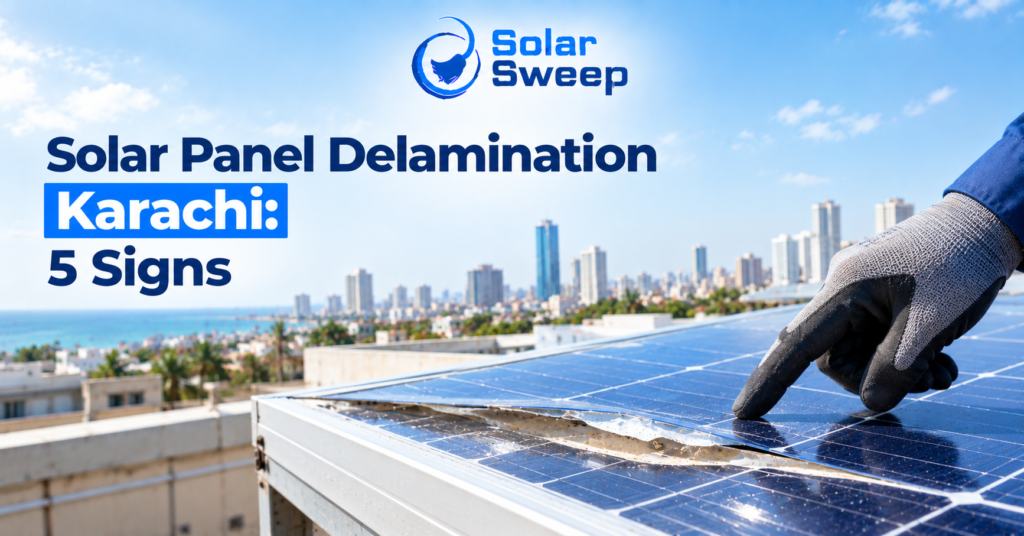
Solar panels are designed for long outdoor service, but not every ageing problem appears as obvious physical damage. Some failures develop inside the module, where heat, humidity, ultraviolet exposure and repeated temperature changes gradually affect the materials holding the panel together.
One important example is delamination.
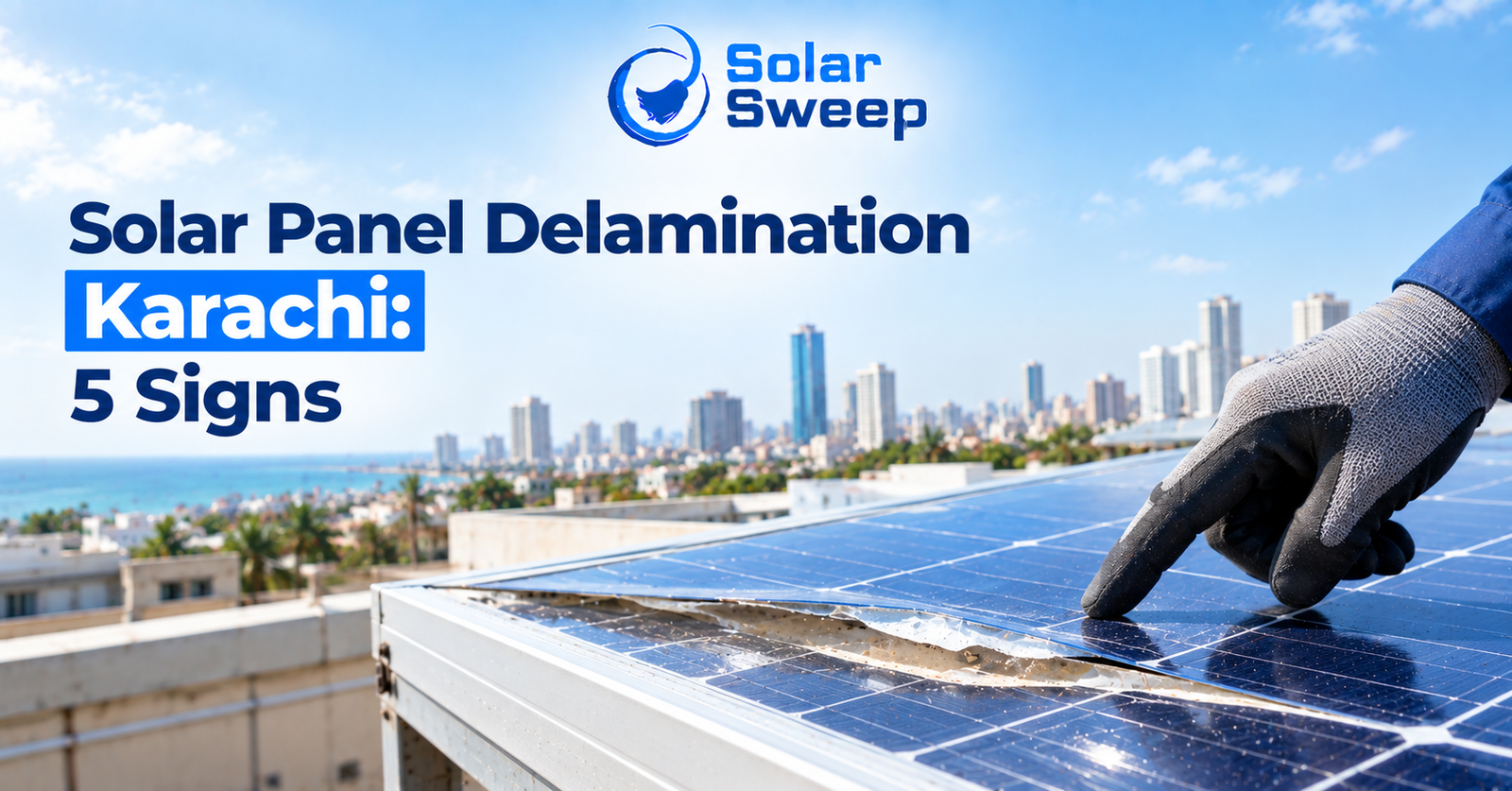
Solar Panel Delamination Karachi is becoming a relevant maintenance consideration as more rooftop and commercial systems remain operational for years. Delamination can weaken the protective structure of a module, allow moisture pathways to develop and contribute to other forms of degradation.
A 2026 study of field-aged photovoltaic modules in Pakistan identified delamination, backsheet deterioration, corrosion and junction-box problems among observed failure mechanisms.
What Is PV Module Delamination?
A PV module is made from several bonded layers, including glass, encapsulant, solar cells and either a backsheet or rear glass.
Delamination occurs when adhesion between these layers weakens and separation begins.
It can appear as bubbles, cloudy areas, visible separation or unusual patterns beneath the glass. However, not every visual mark means a module has failed.
The IEA PVPS failure research identifies delamination as an established PV failure mode and discusses visual inspection, thermography and other diagnostic methods for identifying module defects.
That makes PV Module Delamination Karachi a technical condition that deserves proper assessment rather than a quick visual assumption.
Why Karachi’s Climate Matters
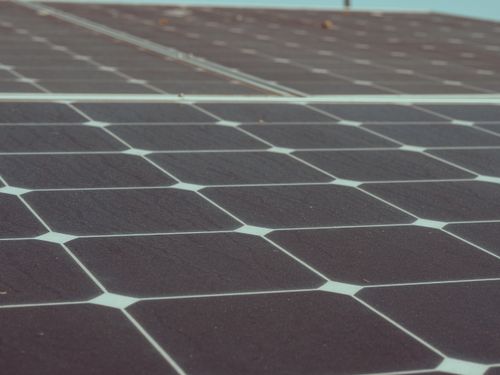
Karachi combines strong solar exposure with high temperatures, seasonal humidity, dust and coastal environmental conditions.
These factors do not automatically cause module failure, but they can influence how materials age over long periods.
The 2026 Pakistan study found that high irradiance, temperature, humidity and thermal cycling can contribute to PV degradation. Among the field-aged modules examined, one type showed a 22% reduction in maximum power, with delamination and other material and component defects identified among the associated problems.
This makes Solar Module Degradation Karachi an increasingly relevant part of long-term solar maintenance.
5 Warning Signs Worth Investigating
1. Bubbles Beneath the Glass
Bubbles or blister-like areas can indicate separation within the laminated structure.
They should not automatically be diagnosed as delamination because reflections, dirt and manufacturing characteristics can sometimes look similar.
However, unusual bubbling deserves closer examination, particularly on older modules.
A professional Solar Panel Delamination Karachi assessment can determine whether the appearance is simply cosmetic or connected to a deeper material problem.
2. Unusual Discolouration
Brown, yellow, cloudy or otherwise unusual areas can indicate ageing within encapsulation materials.
Discolouration alone does not prove delamination, but it becomes more significant when combined with reduced output or visible separation.
A 2025 study of field-exposed modules in a hot, humid climate also identified weak peel strength as an indicator associated with delamination risk.
For PV Module Delamination Karachi, this means visual changes should be considered together with the module’s operating history.
3. Cracked or Separating Backsheet
The rear layer of a module helps protect internal components from moisture, ultraviolet exposure and environmental conditions.
Cracks, bubbling, peeling or separation should therefore receive attention.
The Pakistan research documented backsheet defects including delamination, cracking, bubbling and discolouration in field-aged modules.
This makes Solar Backsheet Failure Karachi an important companion issue when assessing ageing photovoltaic modules.
4. Signs of Moisture Ingress
A compromised protective layer can create opportunities for moisture to reach areas that were designed to remain isolated from the environment.
Moisture can interact with encapsulants, electrical contacts and other internal materials.
The result may not be immediate. A module can continue producing electricity while degradation develops gradually.
That is why Solar Backsheet Failure Karachi should not be treated as an appearance-only problem. The condition of the protective layers can influence long-term electrical reliability.
5. Physical Changes Alongside Lower Output
A production decline can have many causes, including soiling, inverter problems, shading, wiring faults and normal ageing.
But when reduced generation appears alongside bubbling, discolouration, backsheet deterioration or other physical changes, further investigation becomes more useful.
This is where Solar Module Degradation Karachi moves beyond a simple output comparison. Physical condition and performance should be considered together.
Why Early Detection Matters
Delamination can develop gradually.
If separation affects the protective structure, moisture and other environmental influences may reach vulnerable internal components. Over time, this can contribute to additional degradation.
The objective of PV Module Delamination Karachi checks is not to declare every imperfection a failure.
Instead, the objective is to identify modules that require monitoring, additional testing, repair planning or replacement.
That distinction is important. Replacing healthy equipment unnecessarily increases costs, while ignoring a genuine defect can allow a manageable problem to become more serious.
What Professional Maintenance Should Examine
Solar maintenance should go beyond cleaning the front glass.
A technical visit can document module condition, identify suspicious areas, review performance information and determine whether an issue appears isolated or widespread.
For suspected Solar Backsheet Failure Karachi, technicians can pay particular attention to cracking, bubbling, peeling, chalking and other visible deterioration.
Where appropriate, more advanced diagnostic techniques can provide additional evidence. IEA PVPS research identifies thermography and electroluminescence among established approaches for investigating PV module failures.
This makes Solar Module Degradation Karachi assessment more useful when it combines physical inspection with actual system performance.
How Solar Sweep Can Help
Solar Sweep provides professional solar cleaning and maintenance support for residential, commercial and industrial systems.
Cleaning cannot repair internal module degradation, but a professional maintenance visit can help identify visible conditions that deserve further attention.
For older systems, Solar Panel Delamination Karachi assessment can be considered when technicians observe unusual bubbling, discolouration, backsheet deterioration or other physical symptoms.
The practical approach is simple: clean what needs cleaning, document what needs monitoring, and refer genuine electrical or module defects for appropriate technical action.
Why Ageing Modules Need a Different Approach
Solar owners increasingly need to think about the condition of installed assets, not just their original specifications.
As modules remain outdoors for years, Solar Module Degradation Karachi becomes a lifecycle issue involving materials, climate, operating conditions and maintenance quality.
The latest Pakistan research is particularly relevant because it examined field-aged modules under local climatic conditions and identified multiple degradation mechanisms rather than a single universal failure pattern.
For Solar Backsheet Failure Karachi, this reinforces an important point: module ageing should be assessed as a system condition, not judged only by whether the panel is still producing electricity.
The Future of PV Maintenance in Karachi
The solar industry is moving toward more condition-based maintenance.
The IEA PVPS currently highlights reliability, degradation, failure modes and increasingly digital inspection methods as important areas of PV operations and maintenance.
That shift is particularly useful for Karachi’s growing installed base.
PV Module Delamination Karachi is therefore not simply a niche technical term. It represents one part of a broader move toward identifying hidden module degradation before it becomes an expensive operational problem.
For long-term solar owners, Solar Module Degradation Karachi should increasingly be evaluated through a combination of physical condition, performance trends and professional maintenance.
FAQs
What is Solar Panel Delamination Karachi?
Solar Panel Delamination Karachi refers to the separation or weakening of bonded layers within photovoltaic modules operating in Karachi’s environmental conditions.
What causes PV Module Delamination Karachi?
PV Module Delamination Karachi can be associated with material ageing, moisture, temperature cycling, ultraviolet exposure, manufacturing factors and prolonged environmental stress.
What is Solar Backsheet Failure Karachi?
Solar Backsheet Failure Karachi describes deterioration such as cracking, bubbling, peeling, discolouration or delamination affecting the protective rear layer of a PV module.
Can Solar Module Degradation Karachi reduce electricity production?
Yes. Solar Module Degradation Karachi can contribute to lower output, although reduced generation may also result from soiling, inverter faults, shading, wiring problems or other causes.