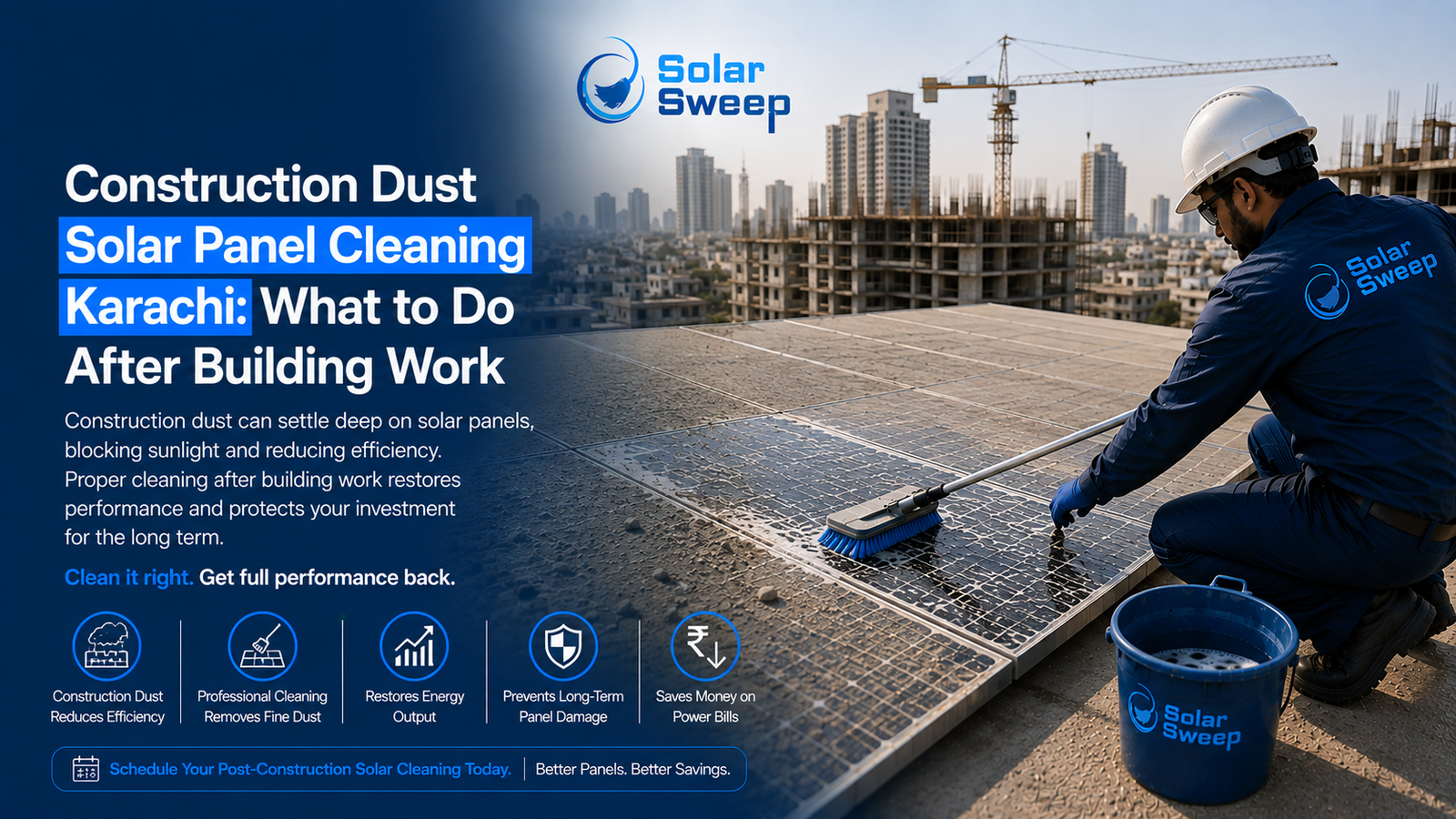
Renovation, neighbouring construction and rooftop civil work can leave solar panels covered with far more than ordinary household dust. Cement powder, sand, plaster particles, drilling residue, paint overspray and fine construction debris can settle across module glass and around frames within a short period.
This makes construction dust solar panel cleaning Karachi particularly important for homes, offices, schools, apartment buildings and commercial properties located near active construction.
The challenge isn’t simply making the panels look clean again. Some construction residues become difficult to remove after mixing with moisture or remaining on hot glass. Incorrect cleaning methods can also scratch modules, affect seals or push debris towards electrical components.
Table of Contents
Why Construction Dust Is Different From Everyday Dust
Normal airborne dust often forms a relatively loose layer that can be removed with appropriate washing. Construction activity produces a more complicated mixture of fine and coarse particles.
After building or renovation work, solar panels may collect:
- Cement powder
- Concrete and sand particles
- Gypsum or plaster dust
- Brick-cutting residue
- Tile particles
- Paint overspray
- Sawdust
- Metal-cutting debris
- Waterproofing residue
The presence of cement dust on solar panels deserves particular attention. Fine mineral particles can settle into module corners and become more stubborn when rain, humidity or cleaning water causes them to stick to the glass.
How Construction Dust Can Affect Solar Production
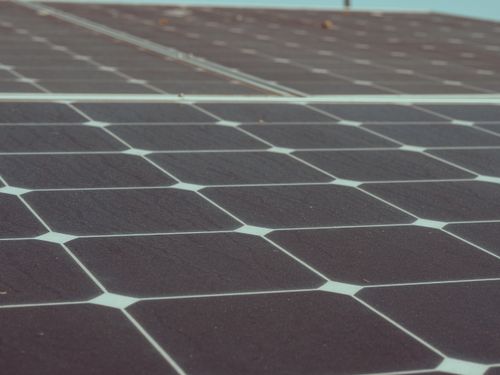
Solar panels need unobstructed sunlight to generate electricity efficiently. A visible layer of dust and construction residue can reduce the amount of light reaching photovoltaic cells.
The IEA Photovoltaic Power Systems Programme identifies soiling as an important cause of photovoltaic underperformance. Its guidance explains that losses depend heavily on local conditions, the type of contamination, rainfall and cleaning practices.
Construction residue may also cover panels unevenly. Modules facing a neighbouring building site can become much dirtier than those on another section of the roof.
For this reason, post-construction solar cleaning should ideally be followed by a review of inverter generation. If output remains unexpectedly low after cleaning, another electrical, shading or equipment issue may need investigation.
Problem 1: Dry Cement Dust Can Scratch the Surface
A heavily dusty panel may look easy to clean with a dry cloth or broom. This can be risky.
Construction dust may contain hard mineral particles. Rubbing these particles across solar glass can create abrasive action, particularly when rough brushes or dirty cleaning cloths are used.
Safe solar panel dust removal should avoid aggressive dry scrubbing.
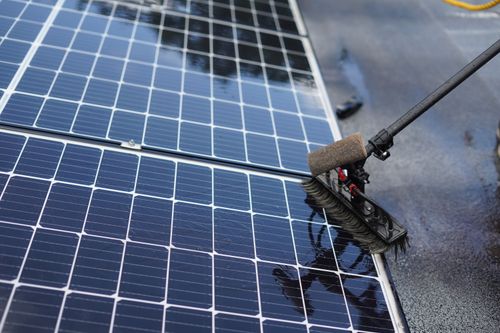
Loose debris should first be removed carefully without forcing particles across the glass. Module-safe tools and suitable water can then be used to clean the remaining contamination.
Problem 2: Cement Residue Can Harden After Getting Wet
Loose cement powder and hardened cement stains require different approaches.
If cement dust mixes with rainwater, rooftop washing or humidity, it can become more firmly attached to the surface. Owners may then be tempted to use blades, metal scrapers or strong chemicals.
That can create greater damage than the original dirt.
When cement dust on solar panels has hardened, the deposit should first be assessed. Technicians need to determine whether it is cement residue, paint, sealant, waterproofing material or another contaminant before deciding how to remove it.
Stubborn deposits should be softened gradually rather than attacked with abrasive tools.
Problem 3: High-Pressure Washing Can Create New Risks
Pressure washing may seem like the fastest way to clean a rooftop covered with construction debris, but photovoltaic systems contain components that shouldn’t be treated like concrete floors.
Junction boxes, connectors, cable routes and module seals can be vulnerable to inappropriate water pressure.
The Trina Solar module user manual recommends soft cleaning tools and suitable water while warning against methods that may damage the glass or module components.
Professional construction dust solar panel cleaning Karachi should therefore use controlled rinsing instead of assuming that more pressure produces better results.
Problem 4: Construction Workers May Damage Modules
Building work around an existing solar array creates risks beyond dust.
Workers may lean ladders or building materials against panels, step between narrow rows, place tools on modules or move cables to access another part of the roof.
Solar panels aren’t designed as walking surfaces.
After significant renovation, post-construction solar cleaning should include a visual inspection for:
- Cracked glass
- Chipped module edges
- Bent frames
- Displaced clamps
- Damaged cable supports
- Loose wiring
- Impact marks
- Changed panel alignment
Cleaning without checking for physical damage may allow a problem created during construction to remain unnoticed.
Problem 5: Debris Can Collect Under the Array
Construction contamination doesn’t remain only on top of the panels.
Plastic packaging, tile pieces, drilling waste, cable offcuts and small pieces of rubble can become trapped beneath the array. This material can restrict roof drainage, interfere with cables or accumulate around mounting bases.
The U.S. Department of Energy recommends routine inspection, cleaning, debris removal and corrective maintenance as part of managing existing photovoltaic systems.
A complete professional solar cleaning Karachi service should therefore examine accessible areas beneath the panels as well as the glass surface.
What Safe Post-Construction Cleaning Should Include
A professional service should begin by identifying the contamination instead of immediately applying water or chemicals.
A practical process can include:
- Inspecting the roof and solar array
- Removing loose building debris
- Checking panels for physical damage
- Carefully removing loose particulate contamination
- Softening stubborn deposits where appropriate
- Cleaning with non-abrasive equipment
- Rinsing using suitable water
- Checking lower module edges and frames
- Inspecting accessible drains and cable routes
- Recording visible defects
Proper solar panel dust removal should be gradual and controlled. The objective is to remove contamination without introducing scratches, electrical problems or roof damage.
Cleaning During Cooler Hours Matters
Karachi rooftop temperatures can become intense during the afternoon.
Cleaning extremely hot panels can cause water to evaporate very quickly, making it harder to rinse away loosened dirt before new marks form. Applying much cooler water to very hot glass also creates unnecessary temperature stress.
Where possible, cleaning should take place early in the morning or later in the day when module surfaces are cooler.
Workers should clean manageable sections rather than wetting the complete array and allowing dirty water to dry before it can be rinsed away.
Don’t Forget the Mounting Structure
Construction workers may accidentally move or damage parts of the solar mounting system while carrying building materials or installing new rooftop equipment.
After construction, accessible structural components should be checked for:
- Loose panel clamps
- Missing bolts
- Damaged rails
- Bent braces
- Cracked FRP components
- Movement around anchors
- Damaged cable supports
- Waterproofing disturbance
The structure shouldn’t be modified simply to create more room for building work. Braces, clamps and supports form part of the original load path.
If something has been removed or changed, it should be assessed before the solar system returns to normal operation.
When Should Post-Construction Cleaning Be Scheduled?
Ideally, full cleaning should take place after the major dust-producing work has finished.
Cleaning too early may result in the panels being covered again the following day. However, allowing thick construction residue to remain for weeks can also reduce generation and make deposits harder to remove.
For longer renovation projects, property owners can use a staged approach:
- Protect the solar work area where practical
- Keep heavy debris away from the array
- Arrange interim inspections during long projects
- Complete final post-construction solar cleaning after dusty work ends
- Review generation afterwards
This approach prevents unnecessary repeated cleaning while avoiding long-term accumulation.
Should Solar Panels Be Covered During Renovation?
Temporary protection may sound sensible, but solar panels continue generating electricity whenever they receive sunlight.
Loose plastic sheets can move in wind, scratch the glass or create unsafe conditions. Covering an energised array can also affect system behaviour.
Property owners shouldn’t simply place sheets over modules without professional guidance.
If significant rooftop construction is planned, protection and temporary shutdown arrangements should be discussed with competent solar and electrical personnel beforehand.
What If Output Remains Low After Cleaning?
Cleaning only corrects contamination-related losses.
Construction activity may also create new shading, damage cables, disturb panel orientation or affect connectors.
If production remains low after solar panel dust removal, technicians should review:
- Inverter alarms
- Daily generation data
- String performance
- Visible cables
- Panel alignment
- New rooftop obstructions
- Physical panel damage
Repeatedly cleaning an already clean system won’t correct an electrical or structural problem.
How Solar Sweep Supports Post-Construction Cleaning
Property owners arranging post-construction solar cleaning with Solar Sweep should explain the type of work completed around the array, especially when cement cutting, drilling, painting, plastering or waterproofing was involved.
A professional service can then approach the contamination according to its condition rather than treating every rooftop with the same washing method.
For professional solar cleaning Karachi, the goal should be to restore a clean module surface while identifying visible issues that may have developed during the construction process.
Final Thoughts
Construction and renovation work can quickly transform a clean solar array into one of the dirtiest parts of a rooftop.
Effective construction dust solar panel cleaning Karachi requires more than simply washing visible dirt away. Cement powder, fine mineral particles and building debris need controlled removal methods that protect the glass, electrical components and mounting system.
A professional approach to cement dust on solar panels, combined with careful inspection and professional solar cleaning Karachi, can help restore cleaner panels while revealing any damage caused during building work.
Completed renovation, waterproofing or construction near your solar array? Book a professional post-construction cleaning assessment to remove building residue safely and restore the system to proper working condition.
FAQs
Can Cement Dust Damage Solar Panels?
Loose cement dust mainly creates a soiling problem, but aggressive removal methods can scratch module glass. Hardened cement should be assessed before scraping or chemical treatment.
Can I Simply Hose the Panels Down?
Water may remove loose particles, but unsuitable pressure or spraying near connectors can create risks. The panel manufacturer’s cleaning instructions should be followed.
How Soon After Construction Should Panels Be Cleaned?
Once major cutting, drilling, plastering and other dust-producing activities are complete, cleaning should generally be arranged promptly.
Will Cleaning Restore All Lost Solar Production?
Not necessarily. Cleaning can restore losses related to surface contamination, but it cannot repair damaged panels, wiring problems, inverter faults or new shading.