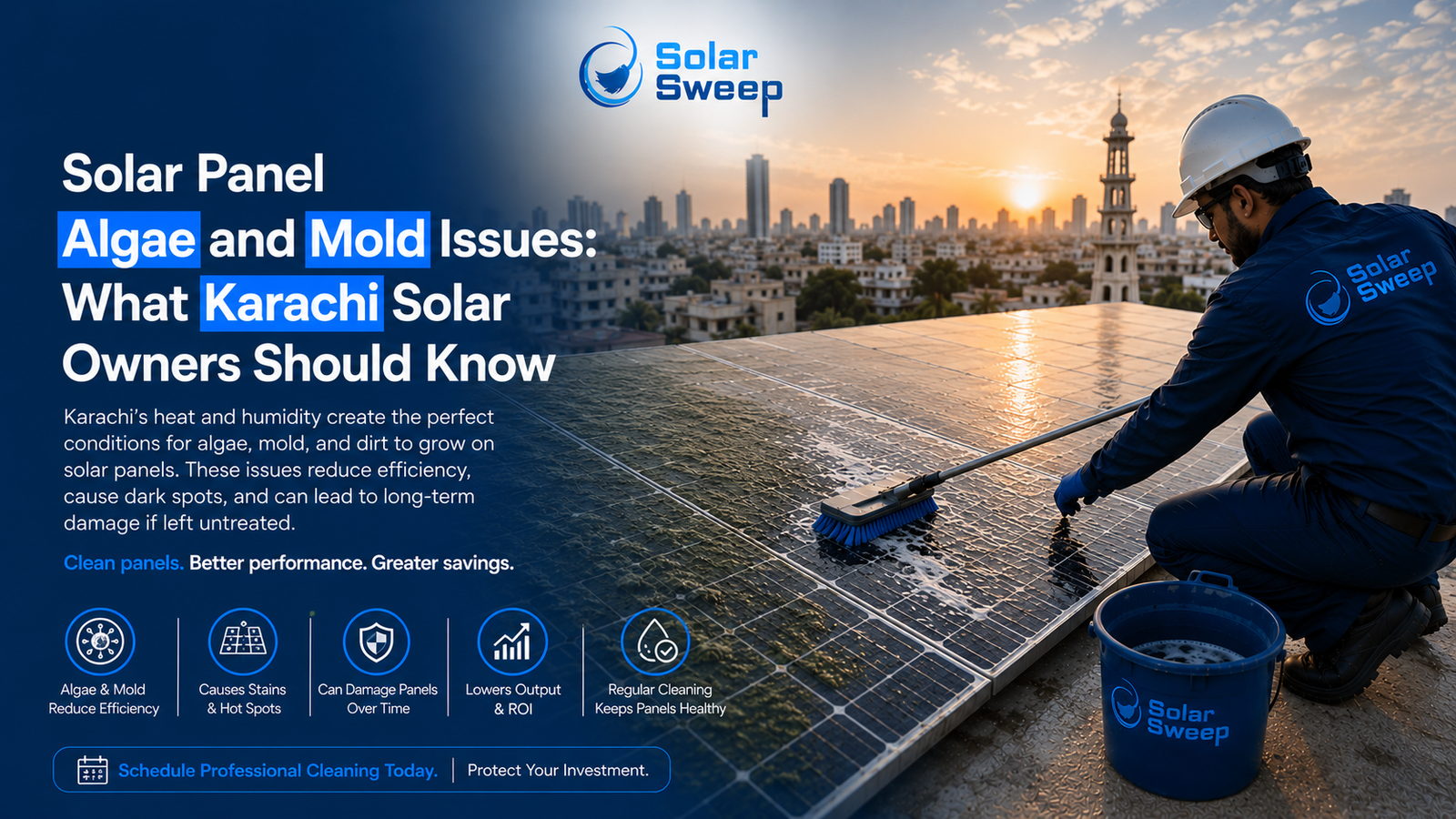
Dust and bird droppings are easy to recognise on solar panels. Biological contamination is less obvious.
Some rooftop systems develop green, brown, black or patchy surface growth around module edges, shaded areas or locations where moisture remains for longer periods. Property owners may describe this as algae, mold or mildew, although the actual contamination can include fungi, bacteria, phototrophic microorganisms and other material forming a surface biofilm.
For anyone considering solar panel algae removal Karachi, the first step is understanding that this isn’t always ordinary dirt. Biological growth can adhere more strongly to glass than loose dust and may return when the conditions encouraging it remain unchanged.
Table of Contents
What Is Biological Soiling?
Soiling is the accumulation of material on the surface of photovoltaic modules. Dust, pollution, sea salt, pollen, leaves and bird waste are common examples, but biological material can also contribute.
The IEA Photovoltaic Power Systems Programme identifies biological debris and growth among the forms of photovoltaic soiling that can reduce energy yield. IEA PVPS estimates that soiling overall is responsible for average global energy losses of approximately 4% to 7%, although losses at an individual site can be much higher or lower depending on conditions.
Biological soiling solar panels can involve microorganisms attaching to the glass and combining with dust and organic material. Over time, this mixture may develop into what is known as a biofilm.
Is It Really Algae or Mold on Solar Panels?
Not every green or dark patch on a solar module is necessarily algae or mold.
A green mark could be organic residue, pollen, lichen or another environmental contaminant. Dark staining may involve fungi, pollution, mineral residue or a combination of materials.
A study published in the Journal of Environmental Management examined microbial colonisation of photovoltaic panels and found that fungi, bacteria and some phototrophic organisms could form part of surface biofilms. In that study, increasing biological colonisation was associated with measurable reductions in photovoltaic output over time.
This research doesn’t mean every Karachi installation will develop the same organisms or experience the same losses. Climate, panel tilt, moisture, pollution and cleaning history differ considerably between sites.
However, visible mold on solar panels or recurring organic-looking growth shouldn’t simply be ignored.
Why Can Biological Growth Develop?
Microorganisms generally need suitable environmental conditions to survive. Solar panels receive intense sunlight, so the centre of a dry, exposed module may not appear like an obvious place for growth.
Conditions can be different around edges and shaded sections.
Growth may be more likely where:
- Moisture remains after cleaning or rainfall
- Panels receive partial shade
- Leaves or bird material collect nearby
- Dust creates a layer that retains moisture
- Roof drainage is poor
- Vegetation is close to the array
- Panel tilt allows water to remain near edges
- The area beneath the array stays humid
A developing solar panel biofilm can combine microorganisms with dust and other environmental material, making the deposit harder to remove than ordinary loose dirt.
Why Karachi Owners Should Pay Attention
Karachi presents a challenging combination of dust, pollution, coastal humidity, bird activity, construction residue and seasonal rain.
Not every rooftop will experience biological growth, but systems where moisture and organic debris remain around modules may deserve closer attention.
Apartment buildings, schools, hospitals, houses with gardens and properties with water tanks or shaded roof sections may have very different micro-environments even within the same neighbourhood.
This is why solar panel algae removal Karachi shouldn’t be treated as a standard procedure used identically on every property. Technicians should first examine the location, type of contamination and surrounding conditions.
Biological Growth Can Add to Existing Soiling
Solar panels rarely experience one type of contamination at a time.
A biological layer may exist alongside:
- Construction dust
- Vehicle pollution
- Bird droppings
- Sea salt
- Mineral water spots
- Leaves
- Industrial particles
This mixture can become more difficult to remove because moisture and organic material may help smaller particles adhere to the module surface.
The problem with biological soiling solar panels is therefore not only appearance. Any persistent layer that reduces light transmission has the potential to affect energy production.
The actual performance effect should ideally be evaluated using inverter or monitoring data rather than estimated from appearance alone.
Warning Signs Solar Owners Should Look For
Property owners don’t need to identify microorganisms themselves. They only need to recognise when the panel surface is behaving differently from ordinary dust.
Possible warning signs include:
- Green or dark patches that return after washing
- Slippery-looking residue
- Organic material concentrated around module edges
- Stains in repeatedly damp areas
- Growth beneath leaves or bird nesting material
- Thick contamination that doesn’t rinse away
- Uneven patches on shaded modules
- Dirt that appears bonded to the glass
Recurring mold on solar panels or algae-like staining should prompt inspection rather than aggressive scrubbing.
Why Ordinary Dry Brushing May Not Work
Loose dust can often be removed relatively easily. Biofilm is different because microorganisms and organic material can attach strongly to a surface.
Trying to scrape stubborn deposits using blades, steel wool, abrasive pads or hard brushes may damage the module glass or protective coating.
This is particularly important during professional solar panel cleaning Karachi, where the objective should be to remove contamination without introducing scratches or other long-term damage.
A stubborn surface mark doesn’t justify using increasingly aggressive tools.
Be Careful With Bleach and Household Chemicals
When property owners hear the words algae or mold, bleach may seem like the obvious solution.
Solar panels aren’t bathroom tiles.
Strong chlorine products, acidic cleaners, solvents and concentrated household chemicals may affect coatings, seals, frames or surrounding rooftop materials. Runoff may also create additional safety and environmental concerns.
The appropriate cleaning agent for solar panel algae removal Karachi depends on the module manufacturer’s instructions and the type of contamination.
Where biological contamination is suspected, the safest approach is to use the mildest effective method compatible with the installed modules.
Cleaning Should Address the Cause Too
Removing visible growth is only half the job.
If standing water, bird nesting material, blocked drainage or persistent shading creates conditions for repeated contamination, the marks may return.
During solar panel algae removal Karachi, technicians should observe the surrounding roof as well as the glass.
Useful checks include:
- Roof drainage
- Leaves beneath modules
- Bird nests
- Water collecting around mounting points
- Nearby vegetation
- Shaded module sections
- Dirt trapped along lower panel edges
- Panel accessibility
Correcting environmental contributors can reduce the chance of recurring contamination.
Inspect the System While Cleaning
The U.S. Department of Energy recommends preventive photovoltaic operations and maintenance that includes monitoring sites for debris, conducting inspections and performing routine cleaning where appropriate.
Cleaning provides an opportunity to observe more than surface condition.
Technicians can look for:
- Cracked module glass
- Loose clamps
- Unsupported cables
- Damaged connectors
- Corrosion
- Blocked roof drains
- Inverter alarms
- Water around electrical components
This makes professional solar panel cleaning Karachi more useful than simply washing the visible glass.
Could Biological Growth Cause Hot Spots?
Any localised obstruction can create uneven illumination across photovoltaic cells. However, seeing green or dark material doesn’t automatically mean a dangerous hot spot exists.
If one area remains heavily shaded or a module continues underperforming after cleaning, further investigation may be justified.
Electrical measurements or thermal imaging may help distinguish surface soiling from cell defects, connector problems or other electrical issues.
Owners shouldn’t diagnose a hot spot from colour alone.
When Should You Arrange Cleaning?
There’s no universal timetable for biological contamination.
Inspection becomes particularly useful when:
- Growth remains after rainfall
- The same patches repeatedly return
- Modules remain shaded and damp
- Organic debris collects beneath the array
- Generation has declined
- Panels haven’t been professionally cleaned for a long period
A visible solar panel biofilm should be dealt with before it develops into a thicker, more difficult layer.
Cleaning frequency should then reflect how quickly contamination returns.
How Solar Sweep Can Help
Solar Sweep provides solar panel cleaning, inspections, energy monitoring and operations and maintenance services for residential, commercial and industrial systems.
When unusual biological-looking contamination is present, the cleaning process should begin with inspection rather than immediately applying strong chemicals.
The team can assess surface contamination, remove debris using appropriate methods and flag visible maintenance concerns around the array.
Where stains remain after safe cleaning, owners may need further assessment rather than repeated abrasive treatment.
Final Thoughts
Algae-like staining, fungal growth and other biological contamination shouldn’t be treated as ordinary dust without first understanding the condition of the panel surface.
A developing solar panel biofilm can combine moisture, microorganisms and environmental debris into contamination that becomes increasingly difficult to remove. Recognising biological soiling solar panels early allows owners to act before the problem spreads or becomes harder to clean.
For Karachi properties, the best approach combines safe cleaning, roof inspection and attention to the environmental conditions allowing contamination to return.
Noticing green, dark or recurring organic stains on your solar panels? Arrange a professional inspection and cleaning service with Solar Sweep before stubborn biological buildup becomes a larger maintenance problem.
FAQs
Can Algae Really Grow on Solar Panels?
Biological organisms can form part of photovoltaic surface contamination under suitable environmental conditions. Research has documented fungi, bacteria and phototrophic microorganisms in solar-panel biofilms.
Is Green Material Always Algae?
No. Colour alone can’t identify the organism. Green residue could involve algae, lichen, pollen or other organic contamination.
Can I Use Bleach to Remove mold on solar panels?
Avoid strong household chemicals unless the panel manufacturer specifically permits them. Incorrect chemicals may affect module surfaces, seals or surrounding components.
Does Rain Remove Biological Growth?
Rain can remove loose contamination, but established biofilm or attached organic material may remain.
Can Biological Soiling Reduce Solar Output?
Yes, when contamination obstructs sunlight. The exact loss varies according to coverage, thickness, module layout and other site conditions.