
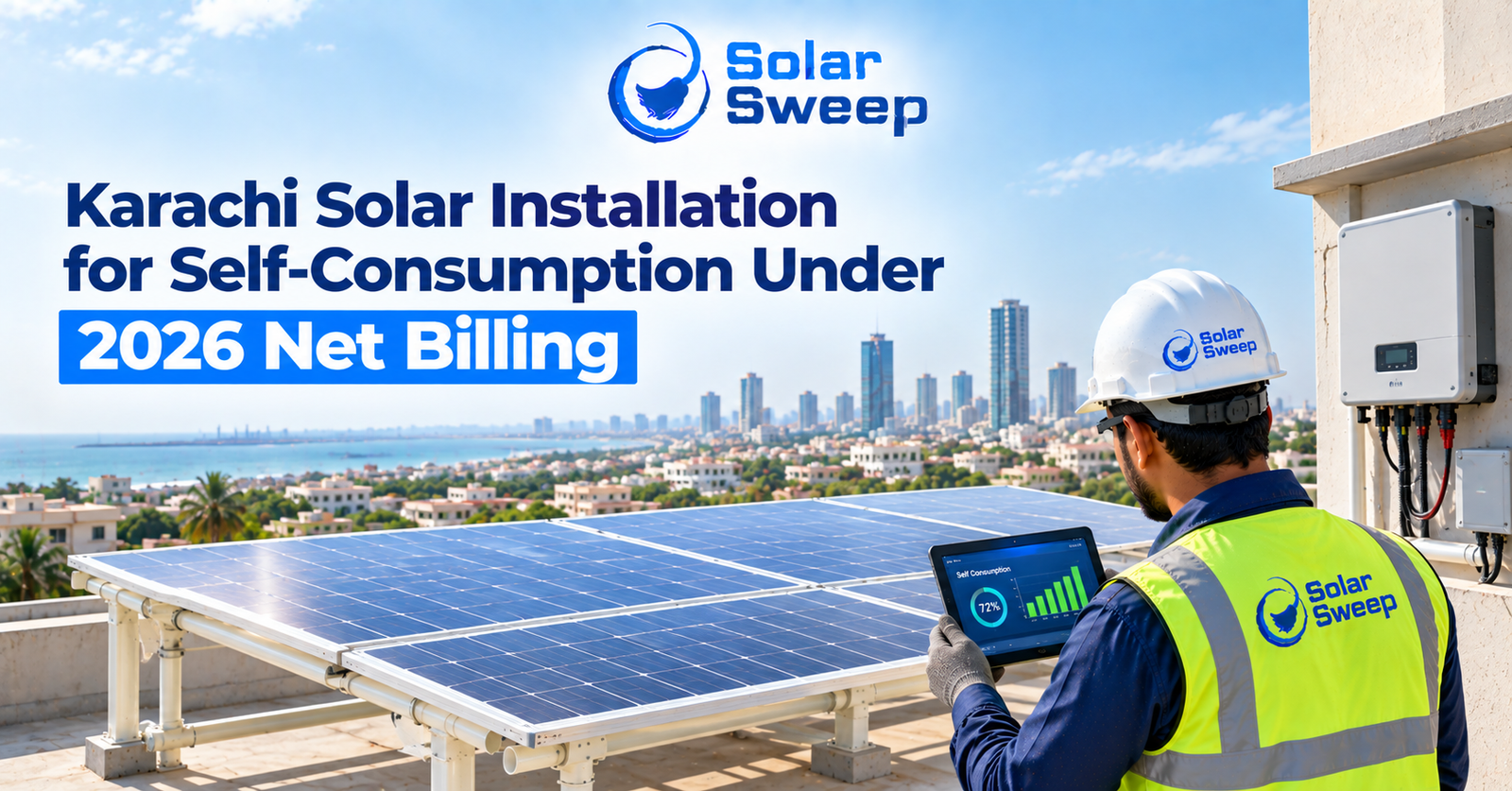
Karachi’s solar market is changing. Solar installation is no longer only about putting as many panels as possible on a rooftop and sending surplus electricity back to the grid. With Pakistan’s 2026 prosumer framework changing the economics of exported electricity, system design increasingly needs to focus on how much solar power a property can actually use.
That makes Solar Self Consumption Karachi an increasingly relevant installation strategy.
Instead of designing a system around maximum export, homeowners and businesses can plan generation around their daytime electricity demand, battery requirements, inverter configuration and operating schedule.
Recent market data shows this shift clearly. The Pakistan Solar Association reported that hybrid inverters reached roughly 75% of imported inverter capacity by July 2026, while on-grid inverter share had fallen sharply.
What Self-Consumption Changes in Solar Installation
Traditional solar planning often starts with annual electricity consumption and a desired system size.
A self-consumption approach starts with a different question:
When does the property actually use electricity?
That question matters because solar production is concentrated during daylight hours. A house with heavy daytime air-conditioning, refrigeration, pumps, appliances or office equipment can directly consume a significant portion of its solar generation.
This makes Solar Load Matching Karachi an important part of modern system planning.
The objective is not simply to install more generation. It is to match generation with useful demand.
Why 2026 Has Changed the Installation Conversation
Pakistan’s 2026 regulatory framework replaced the previous net-metering structure for new distributed-generation arrangements with a net-billing model. Industry analysis identifies this as a major change in the economics of exporting excess electricity.
That makes Solar Self Consumption Karachi more important during the initial design stage.
If exported electricity provides less value than electricity consumed directly on-site, the installation strategy can change. A property may benefit from shifting flexible loads into daylight hours or using battery storage to move solar energy into evening periods.
The result is a more consumption-focused approach to solar installation.

Start With the Property’s Load Profile
A proper Solar Installation Design Karachi assessment should examine electricity use throughout the day rather than relying only on a monthly bill.
Consider a typical home.
Air conditioning may operate heavily during the afternoon. Water pumps may run at particular times. Refrigeration continues throughout the day. Offices may have computers, lighting and cooling operating during working hours.
These loads can consume solar electricity directly.
By contrast, a property with very little daytime consumption may require a different design strategy.
This is why Solar Load Matching Karachi should happen before the final system size is selected.
Solar Generation and Daytime Demand Must Work Together
The most useful solar energy is often the electricity that gets consumed while the panels are producing it.
For Daytime Solar Usage Karachi, the installation process should identify flexible electrical loads that can operate during solar-production hours.
Water pumping, commercial refrigeration, daytime cooling, machinery and certain charging loads can potentially be scheduled around solar generation, depending on the property.
This does not mean every appliance should operate continuously. It means the energy-management strategy should recognize when solar generation is available.
A properly planned Solar Installation Design Karachi can therefore consider both generation and consumption rather than treating the two as separate issues.
Hybrid Inverters Are Changing Installation Design
The growth of hybrid inverter adoption is one of the clearest recent market signals.
According to the Pakistan Solar Association, hybrid inverters increased from around 20% of imported capacity in January 2026 to approximately 76% by May, remaining around 75% in July.
That shift matters for Solar Self Consumption Karachi because hybrid systems can coordinate solar generation, battery storage, household loads and grid supply.
The right configuration still depends on the property’s electricity profile.
A home with strong daytime consumption may prioritize direct solar usage. A home with substantial evening demand may place greater importance on storage. A commercial property may have a completely different load pattern.
Battery Storage Is Not Just About Backup
Battery storage is often discussed as a solution for power outages.
But under the changing economics of solar exports, storage can also influence energy timing.
With Daytime Solar Usage Karachi, excess daytime solar can potentially be stored and used later rather than immediately exported, depending on system configuration and applicable rules.
That makes battery sizing an important part of Solar Installation Design Karachi.
However, installing the largest possible battery is not automatically the right decision. Battery capacity should correspond to actual evening demand, desired backup duration, cycling requirements and the economics of the project.
Designing Around Real Loads
A stronger Solar Load Matching Karachi process begins with actual consumption data.
An installer can examine monthly electricity bills and, where available, interval or inverter data. The next step is to identify the property’s major electrical loads and their operating periods.
For example, a commercial building that consumes most of its electricity between 9 a.m. and 5 p.m. has a very different solar profile from a residence that consumes most of its electricity after sunset.
This information can influence panel capacity, inverter selection, battery sizing and load-management decisions.
It can also prevent oversizing.
What Oversizing Can Change
Installing more panels is not always the same as creating a better financial or operational system.
A large array can produce substantial surplus electricity when the property cannot consume it. Under the current regulatory environment, that makes export assumptions increasingly important.
For Solar Self Consumption Karachi, system sizing should therefore consider usable daytime demand, storage and expected solar production together.
Current Karachi market reporting also shows that hybrid systems are becoming increasingly prominent as buyers adapt to the new policy environment.
The installation conversation is consequently moving from “How many panels fit?” toward “How much solar electricity can this property use effectively?”
Karachi’s Solar Installation Market Is Moving Toward Smarter Sizing
The falling cost of solar equipment has supported continued rooftop demand. Recent Karachi market reporting has also documented reductions in prices for panels, inverters and lithium batteries during 2026.
Lower equipment costs can make solar more accessible, but they do not remove the need for good system design.
For Solar Installation Design Karachi, the installation should still begin with electricity demand, roof conditions, orientation, shading, inverter capacity, battery requirements and expected operating patterns.
That is particularly important when the property’s objective is high self-consumption rather than maximum export.
Building a Solar System Around How You Actually Use Electricity
A modern solar installation should reflect the way a property operates.
For homeowners, that may mean scheduling high-consumption appliances during daylight hours. For businesses, it may involve aligning cooling, pumps, refrigeration or production loads with solar generation.
This is the practical purpose of Daytime Solar Usage Karachi.
A professionally planned system can bring generation, consumption and storage into the same design conversation.
For this type of project, Solar Sweep understands the importance of maintaining solar assets after installation so that the system continues operating effectively as designed.
The New Installation Question
The Karachi solar market is entering a different phase.
The focus is gradually moving beyond simply installing panels toward understanding how electricity is generated, consumed, stored and exported.
For Solar Load Matching Karachi, that means looking at the property’s real load profile.
For Daytime Solar Usage Karachi, it means identifying practical opportunities to consume solar power while it is being generated.
For Solar Installation Design Karachi, it means selecting the panel, inverter and battery configuration around those requirements.
And for Solar Self Consumption Karachi, the central principle is straightforward: design the system around useful energy consumption, not simply maximum generation.
As Pakistan’s solar market adapts to the 2026 regulatory environment, that distinction is becoming increasingly important for new Karachi installations.
FAQs
What is solar self-consumption?
Solar Self Consumption Karachi means using solar electricity directly at the property instead of relying primarily on exporting surplus generation to the grid.
Why is load matching important for solar installation?
Solar Load Matching Karachi helps align solar generation with the property’s actual electricity demand, potentially increasing the amount of generated electricity consumed on-site.
Do hybrid inverters help with self-consumption?
Hybrid inverters can coordinate solar generation, batteries, loads and grid electricity, making them relevant to Solar Installation Design Karachi where storage and energy timing are important.
Should every Karachi solar system have batteries?
Not necessarily. Battery requirements depend on electricity consumption patterns, backup needs, system configuration and the project’s financial objectives. Daytime Solar Usage Karachi can sometimes be improved through load scheduling without requiring a large battery.